
Light is not decoration. It’s architecture.
In no room is this more true than the kitchen. Lighting determines how food is prepared, how people gather, how colors appear, and how the space feels at different hours of the day.
A well-lit kitchen supports life. A poorly lit kitchen creates friction. Lighting is not a finishing touch. It’s infrastructure.
Understanding Lighting as a Functional System
Successful kitchen lighting operates as a layered system.
No single fixture can serve every purpose.
High-performance kitchens balance:
- Ambient illumination
- Task lighting
- Accent lighting
- Natural daylight
- Control systems
When these layers work together, the space feels effortless.
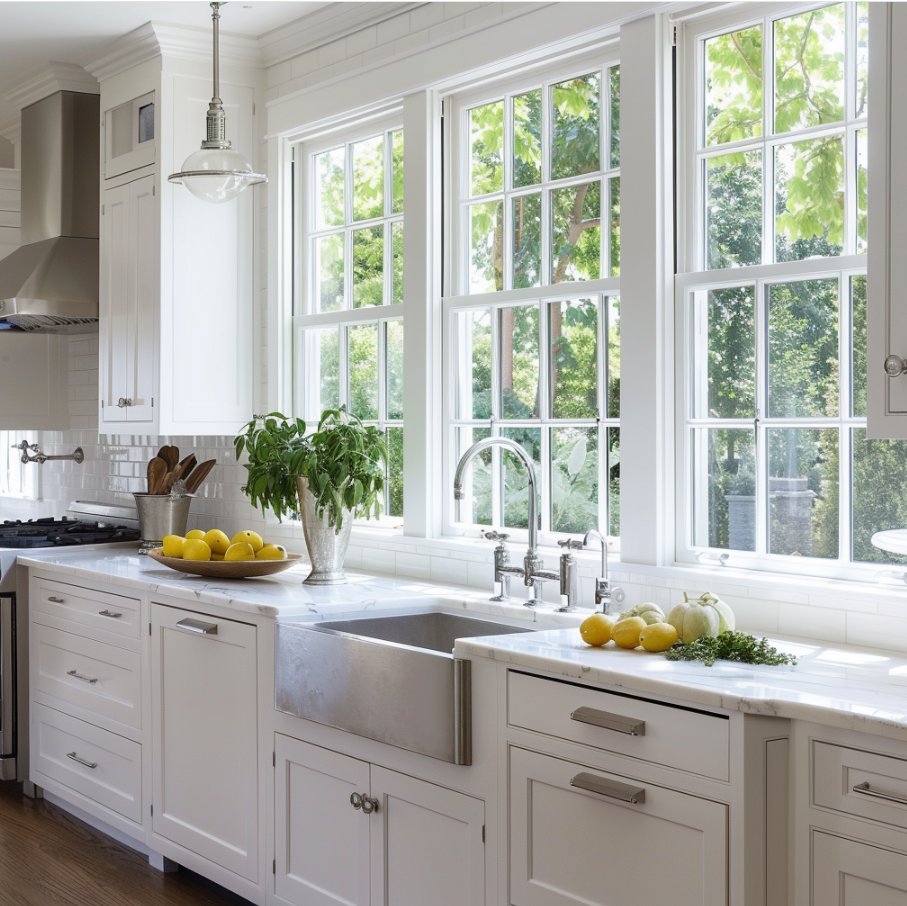
Harnessing Natural Light First
Daylight is the most valuable lighting resource.
Design should prioritize it before adding fixtures.
Window Placement and Orientation
Effective kitchens integrate:
- South-facing windows for winter warmth
- East-facing light for morning energy
- Clerestory windows for privacy
- Skylights for deep-plan spaces
- Glass doors for outdoor connection
Sunlight enhances color accuracy and emotional comfort.
Managing Glare and Heat Gain
Natural light must be controlled.
Overhangs, shades, low-E glass, and strategic orientation prevent overheating and glare without sacrificing brightness.
Balance preserves comfort.
Layer One: Ambient Lighting
Ambient lighting establishes baseline illumination.
It defines how the room feels when no task is occurring.
Ceiling-Based Light Systems
Common ambient solutions include:
- Recessed LED fixtures
- Flush-mount ceiling lights
- Indirect cove lighting
- Linear LED systems
These fixtures should distribute light evenly without creating harsh shadows.
Uniformity supports relaxation.
Color Temperature Selection
Neutral-warm LEDs (2700K–3000K) preserve warmth without yellowing finishes. Cooler temperatures often make kitchens feel clinical.
Temperature affects mood.
Layer Two: Task Lighting
Task lighting supports work.
It prevents eye strain and improves safety.
Under-Cabinet Lighting
Under-cabinet LED strips illuminate countertops directly, eliminating shadows created by overhead fixtures.
They are essential in modern kitchens.
Visibility equals efficiency.
Island and Prep Zone Illumination
Pendant lights, linear fixtures, and focused downlights provide concentrated light over islands and prep surfaces.
These areas require precision.
Layer Three: Accent and Architectural Lighting
Accent lighting adds depth.
It transforms kitchens from functional rooms into living environments.
Highlighting Design Features
Accent lighting often emphasizes:
- Open shelving
- Backsplashes
- Artwork
- Glass cabinetry
- Architectural details
Subtle emphasis creates sophistication.
Toe-Kick and Cove Lighting
Low-level and concealed lighting adds nighttime visibility and visual softness.
It creates atmosphere without intrusion.
Integrating Smart Controls and Dimming Systems
Modern kitchens require adaptability.
Lighting must respond to changing needs.
Multi-Zone Control Systems
Advanced systems allow separate control of:
- Prep lighting
- Dining lighting
- Ambient lighting
- Night lighting
- Outdoor-adjacent lighting
Zoning increases usability.
Dimmers and Automation
Dimming extends fixture life and supports mood transitions. Automation systems allow scheduled adjustments and remote access.
Control creates comfort.
Coordinating Lighting With Materials and Finishes
Light interacts with surfaces.
Design must account for reflection, absorption, and texture.
Managing Reflective and Matte Surfaces
Glossy finishes amplify light. Matte surfaces absorb it.
Balanced kitchens use both strategically.
Contrast creates depth.
Enhancing Color Accuracy
High-quality LEDs preserve true color representation in cabinetry, countertops, and food presentation.
Distorted light undermines design.
Designing for Social and Emotional Experience
Kitchens are gathering spaces.
Lighting should support connection.
Warming Dining and Seating Areas
Warmer, lower-intensity lighting encourages lingering and conversation. These zones benefit from pendants, sconces, and indirect light.
Comfort invites presence.
Supporting Evening and Nighttime Use
Soft night lighting prevents harsh transitions and supports late-night movement without full illumination.
Gentleness matters.
Avoiding Common Kitchen Lighting Mistakes
Many kitchens underperform due to predictable errors.
Common issues include:
- Relying only on recessed lights
- Ignoring under-cabinet lighting
- Using incorrect color temperatures
- Over-lighting small spaces
- Neglecting dimming
Mistakes become daily irritations.
Energy Efficiency and Longevity Considerations
Modern lighting systems prioritize efficiency.
High-quality LEDs reduce energy use and replacement frequency.
Well-designed systems include:
- Long-life fixtures
- Low-wattage outputs
- Smart controls
- Minimal heat generation
Efficiency protects both comfort and cost.
Our Approach at Drapers Homes
At Drapers Homes, we design kitchen lighting as an integrated experience.
We evaluate daylight access, ceiling heights, cabinetry layouts, work zones, and lifestyle patterns before specifying fixtures. Our goal is to ensure every kitchen feels bright when it should, soft when it needs to, and balanced at all times.
We do not install lights. We design atmosphere.
If you are planning a custom home or kitchen renovation in Utah, we are here to help you illuminate your space with clarity, comfort, and intention. Because the heart of the home deserves thoughtful light.