
Every home renovation is an opportunity.
Not to impress. Not to follow trends. But to align structure, materials, and daily life into something that works better than before.
True transformation happens when design choices are supported by craftsmanship, climate awareness, and long-term thinking.
This project reflects that approach.
Designing Spaces That Balance Elegance and Performance
Good design begins with restraint.
Instead of layering features for visual impact, successful spaces rely on proportion, material integrity, and thoughtful integration.
In this home, every element was selected to support durability, warmth, and adaptability—without overpowering the architecture.
Integrating Warm Metals and Structural Wood
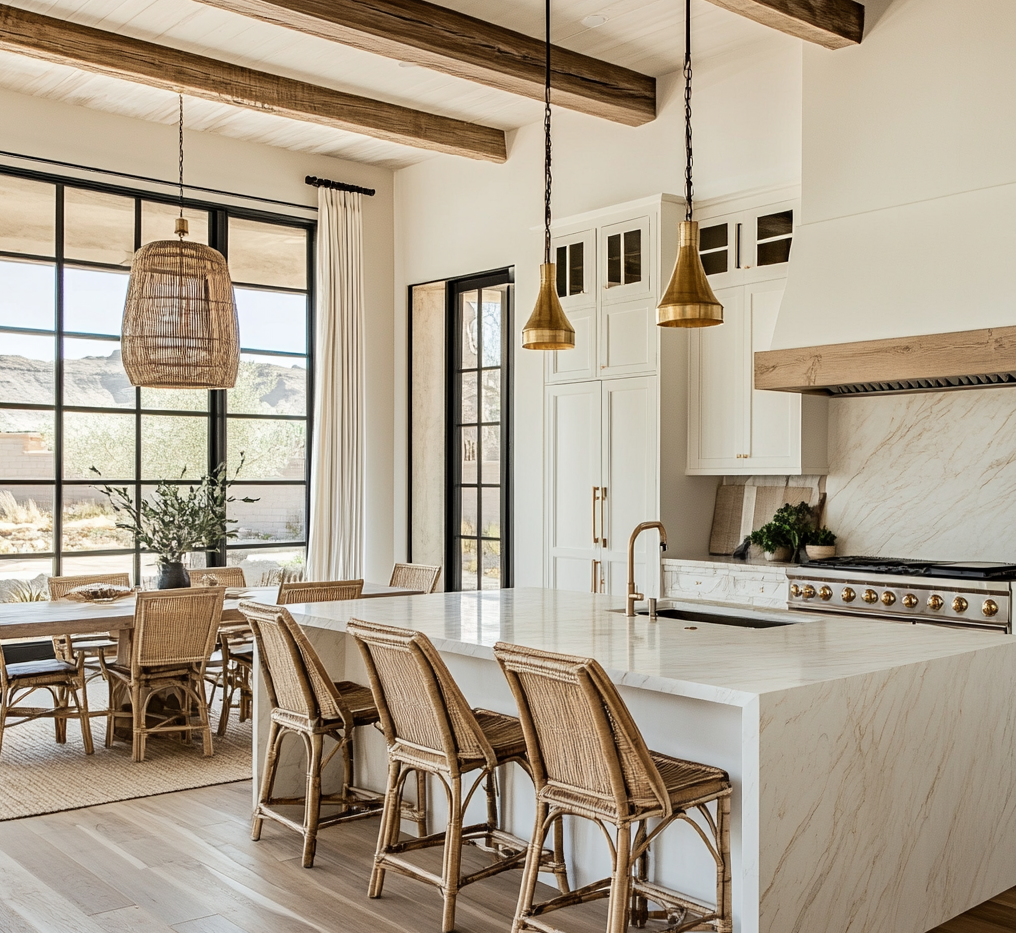
Brushed gold hardware was chosen for its subtle warmth and durability.
Rather than acting as a decorative accent, it reinforces continuity throughout the space and complements surrounding materials. Its finish resists wear while maintaining visual softness.
Exposed wood beams serve both structural and aesthetic purposes. They anchor the room, introduce natural texture, and connect the interior to Utah’s broader landscape.
Together, these elements create balance between refinement and groundedness.
Establishing a Calm Foundation with Neutral Finishes
The walls were finished in Alabaster, a soft, light-reflective neutral that enhances spatial openness without feeling sterile.
This finish supports flexibility, allowing future changes in furnishings or décor without requiring repainting.
Quartz countertops were selected for their strength, consistency, and low maintenance. Their surface resists staining and wear while providing long-term reliability in a high-use kitchen.
Form and function remain aligned.
Designing Lighting and Furnishings for Daily Use
Lighting and furnishings were selected to support real life.
Fixtures provide layered illumination for preparation, gathering, and evening use. Seating and layout encourage conversation without obstructing workflow.
Rather than focusing on statement pieces, the space was designed to remain comfortable, adaptable, and visually calm over time.
Comfort is not an accessory.
It is a design requirement.
Integrating Kitchen Design with Overall Home Flow
This kitchen was not designed in isolation.
Its layout aligns with adjacent spaces, sightlines, and circulation patterns. Storage, appliance placement, and work zones were coordinated to support both everyday use and entertaining.
When kitchens function as part of the home system, they feel effortless.
That is intentional design.
Building for Climate and Longevity
Utah’s climate demands durable construction.
This project was engineered with high-performance insulation, efficient ventilation, moisture management systems, material protection strategies, and energy-conscious planning.
These elements operate quietly in the background, preserving comfort and reducing long-term operating costs.
Performance is invisible when done correctly.
Designing for Change Over Time
Homes evolve.
Families grow.
Work patterns shift.
Needs change.
Design decisions were made with future adaptability in mind. Neutral foundations, flexible layouts, and durable finishes allow spaces to grow with homeowners instead of restricting them.
The goal was not to create a fixed aesthetic.
It was to create lasting freedom.
Our Approach at Drapers Homes
At Drapers Homes, we approach every project as a long-term partnership.
We integrate design, engineering, and construction from the earliest stages to ensure homes perform as well as they look. Our process prioritizes material integrity, climate response, and lifestyle alignment.
We do not build for short-term impact. We build for decades of use.
If you are planning a renovation or custom build in Utah, we are here to help you create a home that reflects both your values and your future.
Because transformation is not about adding more. It’s about building better.