
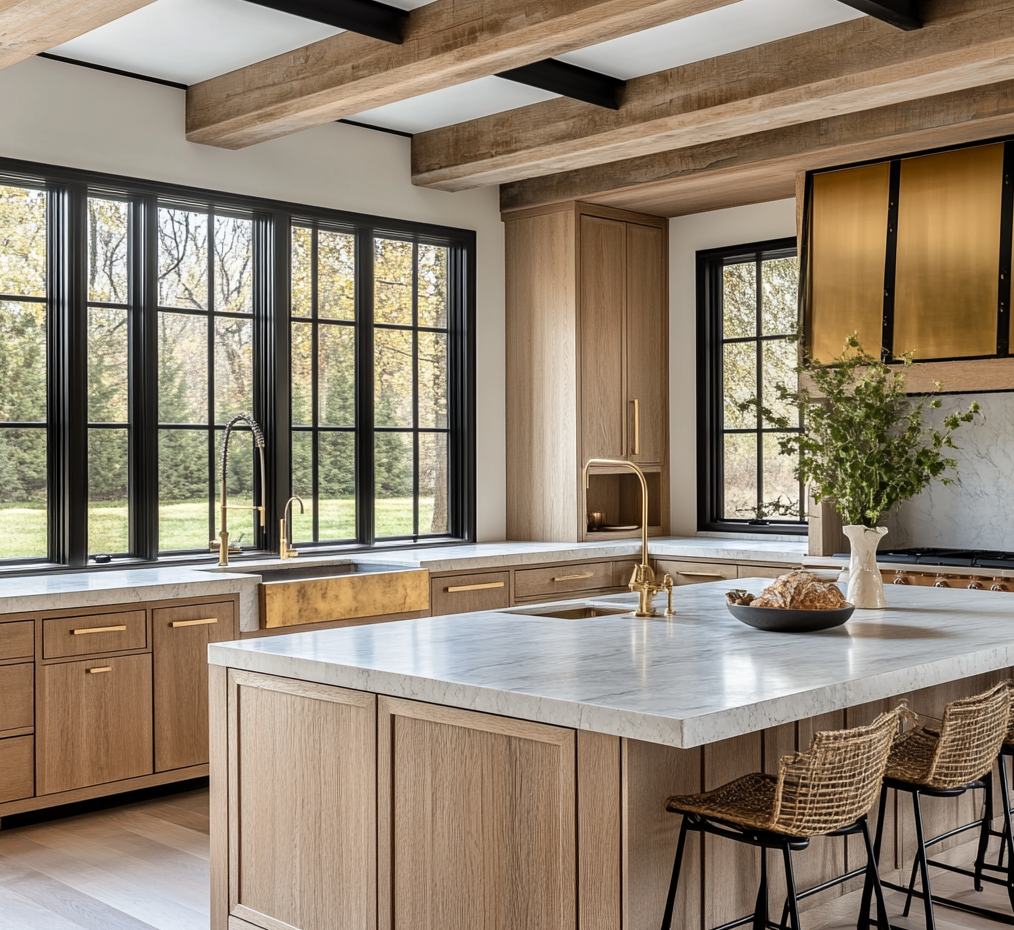
The kitchen is the most worked room in the house.
It handles heat, moisture, traffic, storage, appliances, and daily routines—often all at once. When designed well, it supports life quietly and efficiently. When designed poorly, it becomes a source of constant frustration.
Most kitchen problems are not caused by lack of space. They’re caused by poor decisions made early in the planning process. Understanding what to avoid is just as important as knowing what to include.
Oversized Islands That Disrupt Flow
Large kitchen islands often look impressive in photographs, but they frequently interfere with daily movement.
When an island dominates the floor plan, it restricts circulation, blocks access to appliances, and compresses work zones. A functional kitchen must allow multiple people to move comfortably without obstruction.
Design should serve motion first. Appearance comes second.
Open Shelving That Creates Visual Clutter
Open shelving rarely performs as well as it promises.
While it may appear light and modern in staged images, it requires constant upkeep. Dust, grease, and visual noise accumulate quickly. In most homes, open shelving becomes a source of stress rather than convenience.
Closed cabinetry provides better protection, flexibility, and long-term durability.
Inadequate and Unbalanced Lighting
Lighting mistakes undermine even the most beautiful kitchens.
Relying only on overhead fixtures creates shadows in key work areas and reduces visibility where precision matters. Effective kitchens use layered lighting that includes task, ambient, and accent sources.
Without proper lighting balance, functionality suffers.
Trend-Driven Finishes That Age Poorly
Highly specific colors, novelty textures, and extreme design trends tend to become outdated quickly.
Replacing them is expensive and disruptive. Kitchens are not meant to be rebuilt every few years.
Neutral foundations and timeless materials allow the space to evolve naturally without major renovation.
Poor Storage Planning
Insufficient or poorly placed storage leads to constant clutter.
Kitchens must accommodate cookware, appliances, food, cleaning supplies, and specialty items. When storage is not designed around real habits, countertops become crowded and workflows break down.
Good storage anticipates daily life.
Low-Quality Cabinetry and Hardware
Cabinets and hardware endure constant use.
Drawers that sag, hinges that loosen, and finishes that deteriorate undermine the entire kitchen. These failures are not cosmetic. They affect daily efficiency and long-term value.
Durability is essential, not optional.
Inefficient Appliance Placement
Appliance layout determines how smoothly a kitchen functions.
Refrigerators placed far from prep zones, dishwashers that block walkways, and ovens without adjacent counter space disrupt natural movement patterns.
Good layouts support intuitive motion instead of forcing awkward adjustments.
Overcomplicated Technology
Excessive automation often creates more problems than it solves.
Touchscreens, app-dependent controls, and complex systems can be difficult to maintain and expensive to repair. When technology fails, usability suffers.
Reliable, intuitive appliances provide greater long-term value.
Inadequate Ventilation Systems
Ventilation is frequently overlooked, yet it is critical to kitchen performance.
Cooking produces heat, moisture, and airborne particles that affect air quality and surface durability. Without proper ventilation, cabinets, finishes, and surrounding spaces deteriorate.
A strong ventilation system protects both comfort and construction.
Designing for Long-Term Performance
Good kitchen design is not about chasing trends or maximizing visual impact.
It is about creating a space that performs consistently, comfortably, and reliably.
The best kitchens feel simple because complex thinking happened behind the scenes.
Our Approach at Drapers Homes
At Drapers Homes, we approach kitchen design as a long-term investment in daily life.
We evaluate materials, layouts, systems, and workflows to ensure every element supports how the space will actually be used. Our focus is not on what looks impressive today, but on what will continue to serve homeowners well for decades.
If you are planning a kitchen remodel or new build, we are here to help you avoid costly mistakes and create a space that works as hard as you do.
Because great kitchens are not defined by trends. They are defined by how well they hold up to real life.