
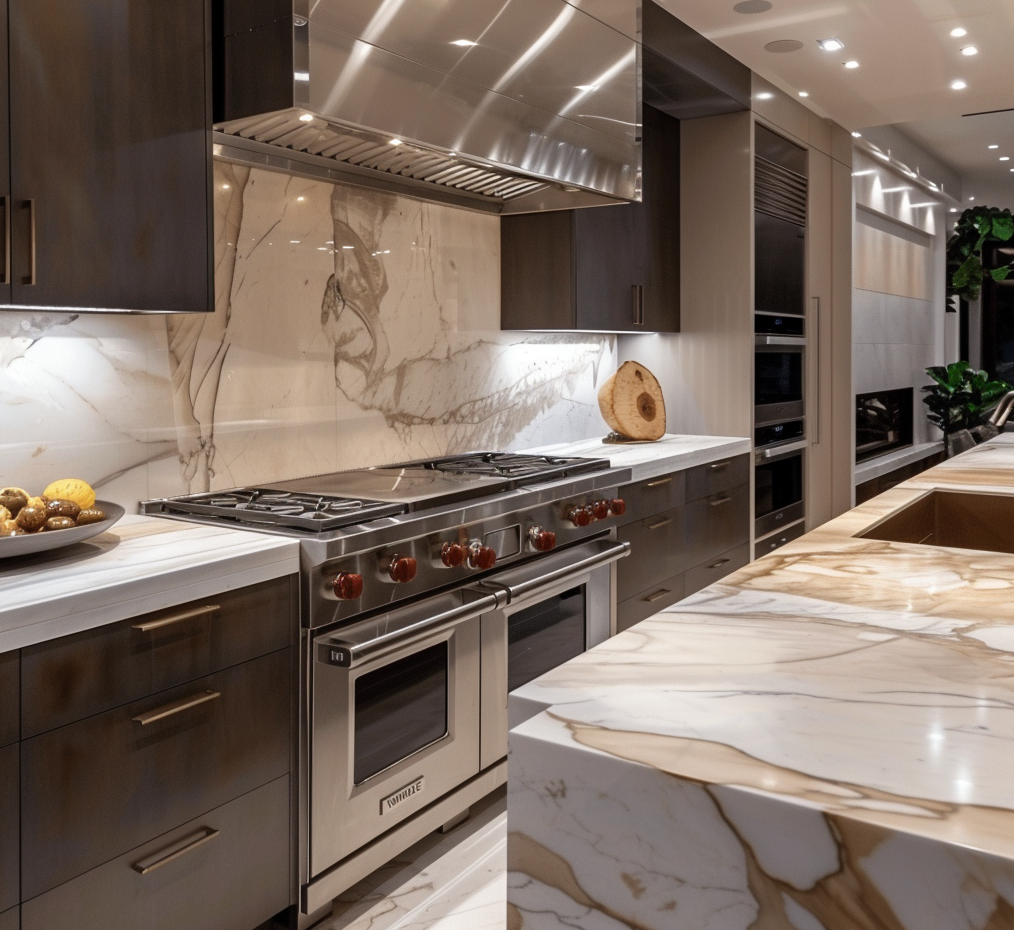
By 2026, countertops are no longer evaluated by appearance alone.
They’re judged by how they perform under pressure—daily use, changing lifestyles, evolving technologies, and growing expectations around sustainability.
Today’s homeowners are not looking for surfaces that impress for a season. They’re choosing materials that will still feel right ten years from now.
Style and function are no longer separate decisions. They’re the same decision.
The Shift Toward Performance-First Design
Modern kitchens are complex environments.
They host cooking, working, gathering, studying, and social connection. Countertops must support all of these roles without becoming fragile, demanding, or visually exhausting.
In 2026, the strongest designs prioritize:
- Material resilience
- Low-maintenance performance
- Visual longevity
- Thermal and moisture stability
- Adaptability to changing needs
Trends now favor systems that reduce future regret.
The Rise of Advanced Engineered Surfaces
Technology-driven materials continue to evolve rapidly.
In 2026, engineered surfaces are leading the market not because they imitate stone—but because they outperform it in many applications.
Ultra-Durable Quartz and Hybrid Composites
New-generation quartz and composite surfaces offer improved impact resistance, heat tolerance, and color stability.
These materials provide:
- Minimal staining
- Improved scratch resistance
- Consistent finish quality
- Reduced maintenance
- Long service life
Designers are selecting these surfaces for homeowners who value reliability over constant upkeep.
Performance has become a luxury feature.
Porcelain Slab Countertops
Large-format porcelain slabs are becoming mainstream in high-performance kitchens.
They are:
- Extremely heat resistant
- UV stable
- Non-porous
- Lightweight relative to stone
- Highly customizable
In 2026, porcelain is no longer considered experimental.
It is established.
Embracing Soft Minimalism and Natural Depth
Visual trends are shifting toward calm, layered neutrality.
Bold patterns and high-contrast finishes are giving way to subtle complexity.
Layered Neutrals and Earth-Based Palettes
Popular color directions include:
- Warm limestone tones
- Soft clay and sand hues
- Muted taupes
- Smoky grays
- Organic off-whites
These palettes harmonize with wood, metal, and textured cabinetry while remaining adaptable over time.
The goal is visual rest.
Not visual stimulation.
Stone-Like Surfaces With Subtle Movement
Homeowners are favoring surfaces that resemble geological formations rather than decorative patterns.
Gentle veining, mineral-inspired textures, and restrained movement create depth without distraction.
Authenticity is replacing spectacle.
Seamless Integration and Architectural Continuity
In 2026, countertops are increasingly treated as architectural elements rather than standalone components.
Full-Surface Applications
Designers are extending countertop materials into:
- Backsplashes
- Waterfall edges
- Integrated shelving
- Wall cladding
- Island surrounds
This creates visual cohesion and reduces material fragmentation.
Continuity communicates refinement.
Integrated Sinks and Drainage Systems
Undermount and integrated sinks are evolving into seamless countertop systems.
Carved, bonded, and molded sink transitions reduce seams and simplify cleaning. These systems also improve hygiene and durability.
Details now carry engineering intelligence.
Sustainability as a Core Design Standard
Environmental responsibility is no longer optional.
By 2026, material sourcing and manufacturing processes are central to purchasing decisions.
Homeowners increasingly favor:
- Low-emission composites
- Recycled-content surfaces
- Water-efficient fabrication
- Locally sourced stone
- Certified production systems
Sustainability has become part of quality assurance.
Not marketing.
Textured, Matte, and Low-Reflective Finishes
Glossy surfaces continue to decline.
Matte and soft-touch finishes dominate in 2026 due to their practicality and visual calm.
Benefits include:
- Reduced fingerprints
- Improved wear concealment
- Lower glare
- More natural appearance
These finishes support kitchens designed for heavy use without constant maintenance.
Designing Specialized Countertop Zones
Kitchens are now organized around behavior rather than symmetry.
Multiple surface types are often used within one space to support different functions.
Common zones include:
- High-durability prep stations
- Heat-resistant cooking zones
- Lower-height baking surfaces
- Integrated workspaces
- Beverage and entertaining areas
Material selection reflects function.
Not uniformity.
Smart Surfaces and Embedded Technology
Early-stage smart countertop technologies are entering mainstream custom homes.
Emerging features include:
- Wireless charging zones
- Embedded temperature sensors
- Touch-activated lighting
- Integrated power access
- Moisture monitoring systems
While still evolving, these systems indicate a shift toward responsive surfaces.
Kitchens are becoming interactive environments.
Balancing Trend Awareness With Timeless Design
In 2026, successful kitchens are trend-aware, not trend-driven.
They use contemporary materials within stable design frameworks.
Strong foundations include:
- Neutral base colors
- High-quality fabrication
- Classic edge profiles
- Balanced thickness
- Universal compatibility
These elements allow surfaces to evolve without replacement.
Longevity remains the ultimate design goal.
Maintenance and Lifecycle Planning
Modern homeowners think in lifecycles.
Before selecting materials, they evaluate:
- Cleaning requirements
- Repairability
- Refinishing options
- Replacement costs
- Long-term appearance
Countertops are now chosen as systems with future implications.
Not disposable features.
Our Approach at Drapers Homes
At Drapers Homes, we evaluate countertops as part of an integrated performance strategy.
We consider cooking habits, climate exposure, lighting conditions, cabinetry systems, and maintenance expectations before recommending materials. Our goal is to ensure every surface supports daily life while remaining resilient and relevant for decades.
We do not select countertops for short-term impact. We select them for sustained excellence.
If you are planning a kitchen renovation or custom home in Utah, we are here to help you navigate material choices with clarity and foresight.
Because the best kitchens are not designed for today. They’re designed for the future you will grow into.